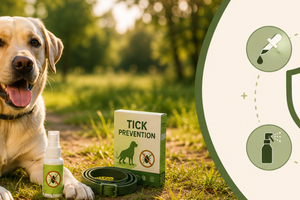
Summer means longer walks, trips outside the city, and more time spent in nature. At the same time, it is the season when dogs are particularly likely to come into contact with grass, bushes, and areas where ticks may be present. Even a regular walk in a city park does not completely eliminate the risk.
Regular tick prevention helps reduce the risk of tick bites and protects your dog from parasites that may transmit infectious diseases. However, it is important not simply to choose any product, but to select a treatment according to your dog's weight, age, lifestyle, and individual needs.
Why regular tick prevention matters
A tick can attach to a dog during an ordinary walk, even when the animal does not enter a forest. After a walk, a parasite may remain on the coat or attach to the skin.
Regular prevention helps:
- reduce the risk of tick bites;
- protect dogs from fleas and other external parasites;
- reduce the risk of diseases transmitted through parasite bites;
- maintain your pet's comfort;
- prevent parasites from multiplying in the home environment.
It is important to remember that no treatment provides an absolute guarantee, so your dog should still be checked after outdoor activities.
When should you treat your dog for ticks?
Do not rely only on the calendar. Tick activity depends on temperature and weather conditions. In many regions, ticks become active in spring, while during a warm autumn or mild winter the risk may continue beyond the summer season.
For this reason, prevention should be carried out consistently according to the instructions for the specific product.
Regular protection is particularly important for dogs that:
- frequently walk in parks and forests;
- spend time in tall grass;
- live in houses with gardens;
- travel outside the city;
- spend a lot of time outdoors.
What types of tick treatments are available?
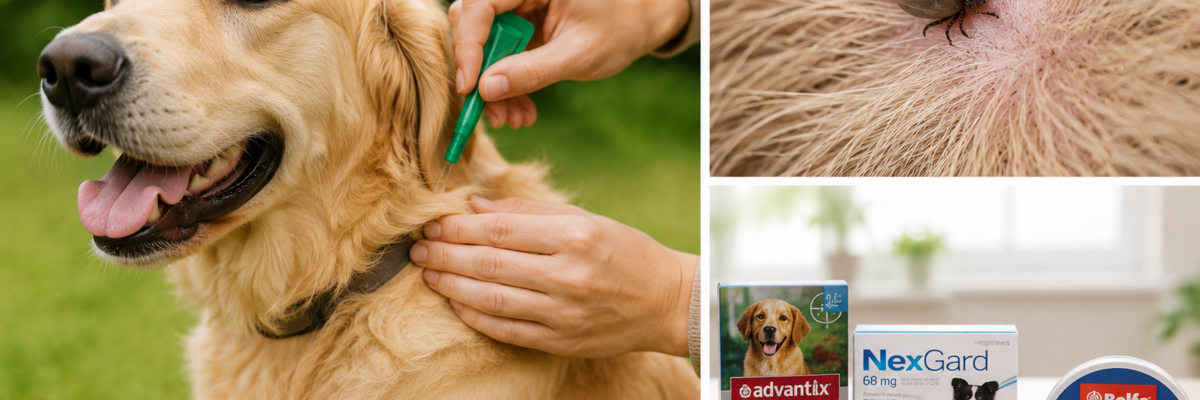
The most common parasite-control products include spot-on treatments, chewable tablets, collars, sprays, and combination products. The range available from Homyak pet store includes products such as Advantix, Advocate, Bolfo, NexGard, Bravecto, and Frontline.
The best option depends on the method that is most convenient for the owner and the product that is appropriate for the individual dog.
Comparison of popular tick treatments
| Product | Format | Main use | May be suitable for |
|---|---|---|---|
| Advantix | Spot-on treatment | Ticks, fleas, and other external parasites | Dogs whose owners prefer regular topical treatment |
| Bolfo | Collar | Protection against external parasites | Owners who prefer a collar |
| NexGard | Chewable tablet | Fleas and ticks | Dogs for which oral treatment is convenient |
The Homyak dog flea and tick treatment category includes products for different weight ranges. For example, Advantix is available for dogs up to 4 kg, 4–10 kg, 10–25 kg, and 25–40 kg, while NexGard is available for different weight categories, including 2–4 kg, 4–10 kg, 10–25 kg, and 25–50 kg.
Advantix: when spot-on treatment is convenient
Advantix is a spot-on product containing imidacloprid and permethrin. According to the manufacturer, it acts against fleas and ticks through contact and also provides repellent activity against ticks, mosquitoes, and some other blood-feeding parasites.
The product is intended for dogs and puppies from the applicable minimum age, with regular treatment according to the manufacturer's instructions.
Several Advantix options are available in the Homyak catalog depending on the dog's weight.
Important: Advantix is intended for dogs and should not be used on cats because of its permethrin content.
NexGard: a chewable tablet option
NexGard differs from spot-on treatments because it is administered orally as a chewable tablet. Its active ingredient is afoxolaner.
The manufacturer states that NexGard is intended for the control of fleas and certain tick species in dogs and puppies of the appropriate age and weight.
The Homyak catalog offers NexGard for different dog weight categories, so it is particularly important to select the package corresponding to your dog's actual body weight.
Bolfo: a collar as an alternative
An antiparasitic collar can be convenient for owners who prefer not to apply spot-on treatments or give their dog tablets.
The Homyak catalog includes Bolfo 66 cm.
Before using any antiparasitic collar, check its instructions, minimum age requirements, duration of protection, and compatibility with other parasite-control products.
How to choose the right treatment
Do not choose a product based solely on price or brand popularity. The same format may be convenient for one dog and unsuitable for another.
Before buying, check:
- your dog's exact body weight;
- the minimum age for use;
- the active ingredient;
- which parasites the product targets;
- recommended treatment frequency;
- possible contraindications;
- compatibility with other veterinary medicines.
Extra care is needed when choosing products for puppies, pregnant or nursing dogs, animals with chronic health conditions, or pets with known sensitivity to medications.
Does your dog need treatment after every walk?
No. Tick treatments are not normally applied after every walk unless the specific product instructions state otherwise. They should be used according to the recommended treatment schedule.
However, regular inspection after walks is strongly recommended.
Pay particular attention to:
- ears and the area around them;
- neck;
- armpits;
- abdomen;
- groin;
- paws and between the toes;
- base of the tail.
If a tick is already attached, remove it as soon as possible using an appropriate tick-removal tool or contact a veterinarian.
Can you use several tick treatments at the same time?
Do not combine several antiparasitic products without professional advice. For example, you should not automatically give a tablet, apply spot-on drops, and use a collar at the same time without checking whether the products are compatible.
Additional protection may be appropriate in certain situations, but the combination should preferably be discussed with a veterinarian.
What should you do if a tick bites your dog?
Preventive treatment does not eliminate the need to act when an attached tick is found.
If you find one:
- Remove the tick as soon as possible.
- Do not crush it with your fingers.
- Clean the bite area.
- Monitor your dog's condition.
- Contact a veterinarian if unusual symptoms appear.
Lethargy, loss of appetite, fever, weakness, or changes in behavior after a tick bite require attention. Do not simply wait for the symptoms to disappear.
How to organize protection throughout the summer
The easiest way to avoid missing a treatment is to associate it with a specific date. For example, if the product is administered monthly, set a recurring reminder on your phone.
A simple routine is:
- weigh your dog before choosing a product;
- select a treatment appropriate for the dog's weight;
- record the treatment date;
- set a reminder for the next dose;
- regularly inspect the coat and skin after walks;
- never use expired or damaged products.
Summer tick protection is not a one-time procedure but an ongoing prevention routine. Spot-on treatments, chewable tablets, and antiparasitic collars all work differently, so the most appropriate option depends on the individual dog and the specific product instructions.
The Homyak dog flea and tick treatment category includes different types of flea and tick products, including Advantix, Bolfo, and NexGard, as well as other antiparasitic treatments. Always check the dog's weight, age, indications, and the instructions for the exact product before use.